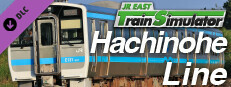
JR EAST Train Simulator: Hachinohe Line (Hachinohe to Kuji) Kiha E130-500 series
JR EAST Train Simulator: Hachinohe Line (Hachinohe to Kuji) Kiha E130-500 series - Steam Charts & Historical Stats
The Hachinohe Line connects Hachinohe Station in Hachinohe City, Aomori Prefecture with Kuji Station in Kuji City, Iwate Prefecture. Explore historical player activity and pricing for JR EAST Train Simulator: Hachinohe Line (Hachinohe to Kuji) Kiha E130-500 series. Player-count data was last observed Apr 22, 2026.
JR EAST Train Simulator: Hachinohe Line (Hachinohe to Kuji) Kiha E130-500 series player count and price summary
- Current players
- Unavailable
- All-time peak
- Unavailable
- 24-hour player change
- Unavailable
- Current US price
- Price unavailable
Player count last observed . Values marked unavailable are not estimated.
Media gallery 22 screenshots · 1 videos
Screenshots
Videos
八戸線DLC
Game Insights
Value Score
Price-to-player ratio ranks in the 50th percentile.
System Requirements
- Requires a 64-bit processor and operating system
- OS: 64-bit Windows 11
- Processor: Intel Core i5-8500 or AMD Ryzen 5 2600
- Memory: 16 GB RAM
- Graphics: NVIDIA GeForce GTX 1060 (VRAM 6GB)
- DirectX: Version 12
- Storage: 20 GB available space
- Additional Notes: need resolution 1920×1080@60Hz
- Requires a 64-bit processor and operating system
- OS: 64-bit Windows 11
- Processor: Intel Core i5 12400 or AMD Ryzen 5 5500
- Memory: 16 GB RAM
- Graphics: NVIDIA GeForce RTX 3060 (VRAM 8GB)
- DirectX: Version 12
- Storage: 20 GB available space
- Additional Notes: Recommended SSD
Additional Information
*languages with full audio support
Current Pricing
Additional Information
Developer Analytics
Loading competitors...
About This Game
The Hachinohe Line connects Hachinohe Station in Hachinohe City, Aomori Prefecture with Kuji Station in Kuji City, Iwate Prefecture.Some sections of the line offer views of the ocean, making it a popular route for passengers to see the ocean from the train windows.
Detailed Description
The line was first opened in 1894 between Shiriuchi Station (now Hachinohe Station) and Hachinohe Station (now Hon'hachinohe Station), and was repeatedly extended and opened to service until 1930, when the line was extended to Kuji Station, bringing the Hachinohe Line into full service.
With the opening of the Tohoku Shinkansen bullet train line extension between Hachinohe and Shin-Aomori stations in December 2010, the line between Hachinohe and Aomori stations, which had previously been on the Tohoku Main Line, was transferred to Aomori Railway, and is now a line with no connections to other JR conventional lines.
In October 2013, "TOHOKU EMOTION," a sightseeing train with a restaurant space throughout the train, began operation between Hachinohe and Kuji Stations, mainly on Saturdays and holidays.
The train line is divided into two separate lines: one between Hachinohe Station and Same Station for urban transportation, and the other between Hachinohe and Kuji Station for interregional transportation.
The majority of the route runs along the coastline, including the Tanezaki Coast, a national scenic beauty spot and a breeding ground for petrels. From Hachinohe Station to Same Station, the line runs through factories and urban areas; from Same Station to Rikuchu-Nakano Station, it runs through rural areas and along the Pacific Ocean; and from Rikuchu-Nakano Station to Kuji Station, it runs through hilly areas. Some sections of the line offer views of the ocean, making it a popular route for passengers to see the ocean from the train windows.
Supplementary information
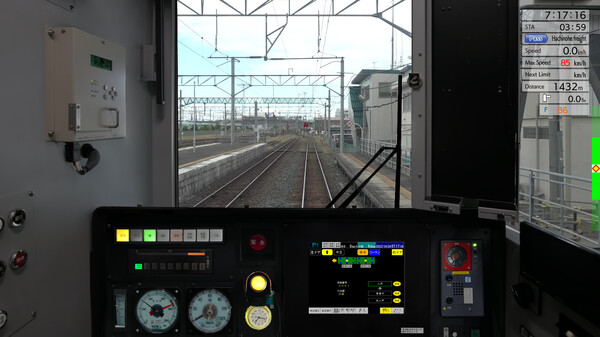
- In Kiha E130-500 Series, the "Speed suppression (1)" and "Speed suppression (2)" functions can be used only when the main handle is not in the accelerator.
- Speed suppression (1): Deceleration brake (Low) - "D" key
- Speed suppression (2): Deceleration brake (high) - "W" key
Highlights
- City section/Hachinohe Station - Same Station
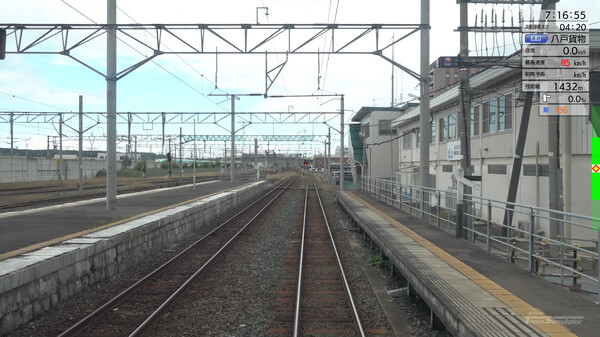
- Parallel section with Hachinohe Waterfront Railway Line/Hachinohe Freight Station - Hachinohe Station
- Mabechi River/Hachinohe Freight Station - Hachinohe Station
Crossing the Mabechi River railway bridge. The track branching off to the left before the Mabechi River railway bridge used to be utilized as a freight line. - Branch on elevated line/Hon-Hachinohe Station - Konakano Station
The Hachinohe line splits into two directions on the elevated railway line, and the Hachinohe line turns to the right. The straight track used to be a freight branch line of the Hachinohe Line that ran to Minato Station. - Niida River/Konakano Station - Mutsu-Minato Station
Cross the railroad bridge over the Niida River. - Playpia Shirahama Station/Same Station - Mutsu-Shirahama Station
A temporary station that operated until 1995; it was discontinued in 2012 and the station platform has now been removed. - Seaside section/Same Station - Mutsu-Shirahama Station
The Pacific Ocean can be seen on the left. The train climbs up the gradient at once. - The station where you can cross paths with oncoming trains/Hashikami Station
This station has a pair of platforms that allow trains to pass each other on the opposite side of the station. In front of the station, a sleeper signal used at this station is preserved. - Running along the coast/Shukunohe Station - Rikuchu-Yagi Station
The station has a relative platform and can exchange trains with oncoming trains, and was the last JR station to use semaphore signals until they were removed in 2005. - Seaside Section/Rikuchu-Yagi Station - Uge Station
Uge Beach is located just outside of Uge Station. - Mountainous section/Rikuchu-Nakano Station - Rikuchu-Natsui Station
The train runs through the mountains. - Running down the mountain/Samuraihama Station - Rikuchu-Natsui Station
The train runs down the mountain and enters the urban section. - Kuji River/Rikuchu-Natsui Station - Kuji Station
Just before arriving at Kuji Station, the train will cross a railroad bridge over the Kuji River.
Route Information
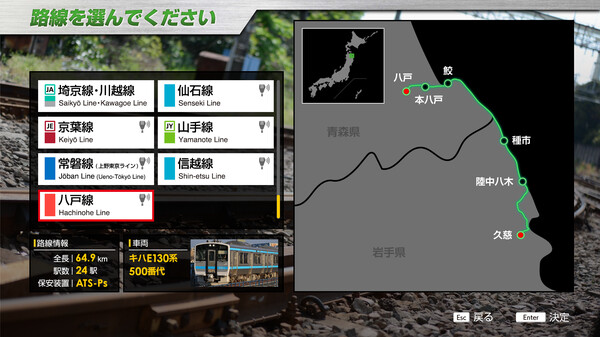
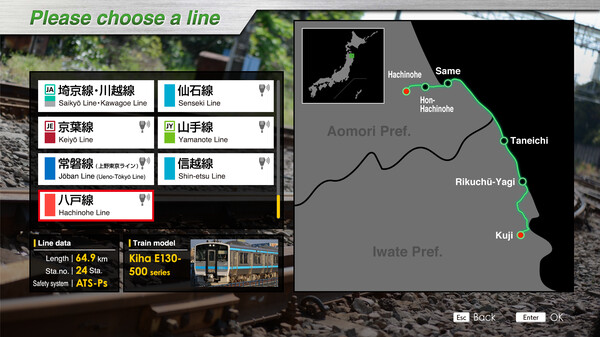
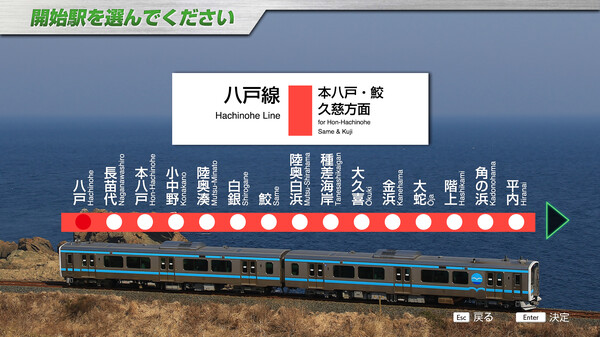
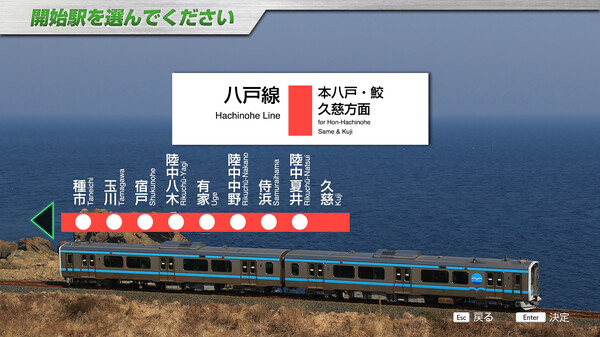
- Section: Hachinohe Line Outbound Hachinohe ⇒ Kuji
- Total length: 64.9 km
- Number of Stations: 24
- Security equipment: ATS-Ps
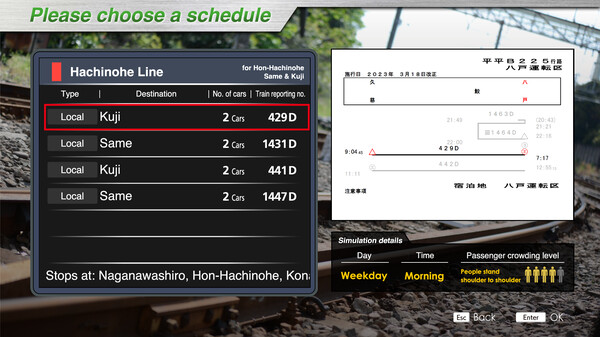
Train schedules that can be operated
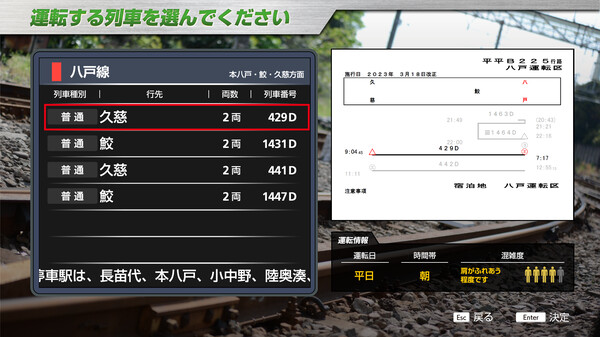
- Train Number:429D
- Type/Destination: Local train to Kuji
- Section where you can drive: Hachinohe to Kuji
- Type of train: Series Kiha E130-500, 2 cars
- Responsible for real voice train announcements: Hachinohe train crew depot
- Train Number:1431D
- Type/Destination: Local train to Same
- Section where you can drive: Hachinohe to Same
- Type of train: Series Kiha E130-500, 2 cars
- Responsible for real voice train announcements: Hachinohe train crew depot
- Train Number:441D
- Type/Destination: Local train to Kuji
- Section where you can drive: Hachinohe to Kuji
- Type of train: Series Kiha E130-500, 2 cars
- Responsible for real voice train announcements: Hachinohe train crew depot
- Train Number:1447D
- Type/Destination: Local train to Same
- Section where you can drive: Hachinohe to Same
- Type of train: Series Kiha E130-500, 2 cars
- Responsible for real voice train announcements: Hachinohe train crew depot