
Total War: ROME II - Beasts of War Unit Pack
Total War: ROME II - Beasts of War Unit Pack - Steam Charts & Historical Stats
Total War: ROME II – Beasts of War Marshall your savagery, and strike primal fear into the hearts of your enemies with the Beasts of War unit pack for ROME II. Explore historical player activity and pricing for Total War: ROME II - Beasts of War Unit Pack. Player-count data was last observed May 2, 2026.
Total War: ROME II - Beasts of War Unit Pack player count and price summary
- Current players
- Unavailable
- All-time peak
- Unavailable
- 24-hour player change
- Unavailable
- Current US price
- $2.99
Player count last observed . Values marked unavailable are not estimated.
Media gallery 6 screenshots · 1 videos
Screenshots

Videos

Rome 2 Beasts of War ESRB
Game Insights
Buy Verdict
Not the best time to buy. Price could improve with future sales.
Value Score
Price-to-player ratio ranks in the 100th percentile.
Genre Benchmarks
Latest News
Price History
System Requirements
- OS *: XP/ Vista / Windows 7 / Windows 8
- Processor: 2 GHz Intel Dual Core processor / 2.6 GHz Intel Single Core processor
- Memory: 2 GB RAM
- Graphics: 512 MB DirectX 9.0c compatible card (shader model 3, vertex texture fetch support).
- DirectX: Version 9.0c
- Storage: 35 GB available space
- Additional Notes: Screen Resolution - 1024x768
- OS *: Windows 7 / Windows 8
- Processor: 2nd Generation Intel Core i5 processor (or greater)
- Memory: 4 GB RAM
- Graphics: 1024 MB DirectX 11 compatible graphics card.
- DirectX: Version 11
- Storage: 35 GB available space
- Additional Notes: Screen Resolution - 1920x1080
- Requires an Apple processor
- OS: macOS: 15.0
- Processor: Apple M1 (8-core CPU)
- Memory: 8 GB RAM
- Graphics: Apple M1 (7-core GPU)
- Storage: 50 GB available space
Additional Information
*languages with full audio support
Current Pricing
Additional Information
Developer Analytics
Loading competitors...
About This Game
Total War: ROME II – Beasts of War Marshall your savagery, and strike primal fear into the hearts of your enemies with the Beasts of War unit pack for ROME II. Comprising seven new battlefield units, Beasts of War brings further variety to ROME II’s already diverse unit roster.
Detailed Description
Marshall your savagery, and strike primal fear into the hearts of your enemies with the Beasts of War unit pack for ROME II. Comprising seven new battlefield units, Beasts of War brings further variety to ROME II’s already diverse unit roster.
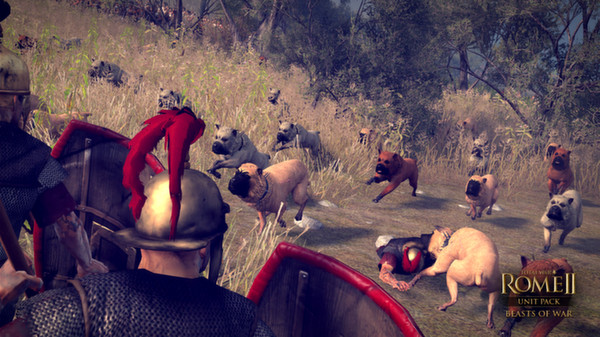
Terrorise your enemies and slow their progress with beehive, scorpion and snake-pot ballistas, or crush them under the weight of heavily-armoured Cataphract Camels and Mercenary Syrian Armoured Elephants. And when their will is broken and they flee the field, run them down with two new breeds of ferocious war-dogs.
Beasts of War brings introduces the following recruitable units to ROME II:
• Molossian Dogs
Can be recruited by: Epirus
A heavily muscled beast from western Greece, the now-extinct Molossian is considered to be the predecessor of many of today’s larger breeds, such as the Rottweiler and Great Dane. Used as both a guard dog and in battle, Virgil remarked “never, with them on guard, need you fear for your stalls a midnight thief, or onslaught of wolves, or Iberian brigands at your back.” These vicious dogs do not tire easily, and never lose the scent of an enemy.
• Beehive Onager
Can be recruited by: Athens, Epirus, Macedon, Sparta, and Syracuse
Whilst large-scale beekeeping for agricultural purposes was a later innovation, the humble honeybee nevertheless held an important place in ancient Greek culture. A trio of mythical nymphs, the Thriae or ‘bee maidens’, were loved by Apollo and Poseidon, bearing their children. Bees also have a practical application in battle, as a swarm of angry bees will always cause troops to stall and panic.
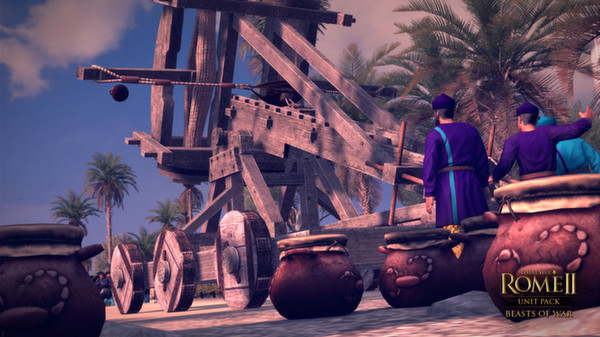
• Scorpion Pot Ballista
Can be recruited by: Pontus, Parthia
Home to the most lethal scorpions in the known world, whose sting can paralyse and kill a man within an hour, it was only a matter of time before a wily Middle Eastern general used them against his enemies. Spare a thought, then, for the Roman emperor Severus; whilst besieging the Parthian city of Hatra, his army was showered with pots of scorpions from atop the city walls. Like Trajan before him, Severus failed to breach the defences, even after two attempts.
• Snake Pot Ballista
Can be recruited by: Carthage
Perhaps the most famous use of potted animals was Hannibal Barca’s tactic against the fleets of Eumenes II of Pergamon. Hurling large clay pots full of venomous snakes onto the decks of Eumenes’ ships; he panicked the enemy fleet and won the day. Any unit struck by writhing, venomous snakes will pause to consider the wisdom of marching onwards!
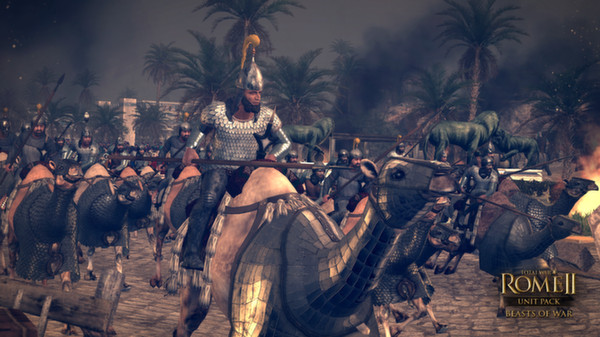
• Camel Cataphracts
Can be recruited by: Parthia
The Roman general Macrinus was not noted for his experience, although had another fought the Battle of Nisbis in 217 AD, it’s hard to imagine he’d be any less stunned by the Parthian cataphract camels fielded that day. Wearing coats of tough, yet flexible, scale-mail, they made an awesome and terrifying sight as they punched through the frontlines and spooked the Roman horses with their camels’ earthy stench.
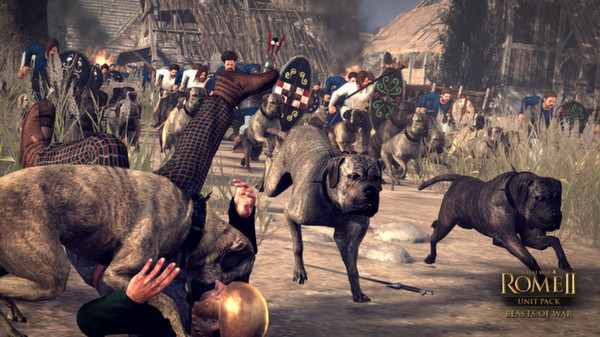
• Celtic Warhounds
Can be recruited by: Iceni, Cantiaci, Caledones, Demetae, Dunmonii, Brigantes, and Ebdani
Dogs have always been useful for guard, patrol and scout work. With skilled handlers they can also be used effectively on the battlefield. Attack dogs were specifically bred and trained to ignore the noise and chaos of combat. The Celtic tribes of the late Iron Age put them to great use. Their speed and ferocity made them ideal shock-troops, and perfect for running down fleeing stragglers.
• Mercenary Syrian Armoured Elephants
Can be hired as mercenaries in: Dura, Antioch, Tyros, and Palmeira
Indian elephants first came to the Middle East when Seleucus, one of Alexander the Great’s Successors, invaded India in 305 BC. 500 war elephants were handed over as part of the peace treaty between the Seleucid dynasty and the Mauryans of India, and the Seleucids went on to breed many more from this initial stock. War elephants remained an important part of the Seleucid army until their defeat by the Romans at Magnesia in 190 BC, following which they were forbidden from breeding more.
• Wolf Warriors
In the Germanic world, the cult of Wodenaz was so large that people of the age often had wolf-related names, such as Vulfolaic ("Wolf-dancer"), Wolfhetan ("Wolf-hide"), and Wolfdregil ("Wolf-runner"). Wolfgang, or "Wolf-gait", has remained a popular German name to this day. The Wolf Warriors, available to the Suebi and as mercenaries for holders of any province in Germania, drape themselves in wolf-hides and fight with the spirit of Wodenaz.
• Sobek Cultists
Defender of the Nile and protector of Pharaoh's power, Sobek was the crocodile-headed god of ancient Egypt from the Old Kingdom period through to the Ptolemaic dynasty and beyond. As such, crocodiles were venerated for their violent, primal qualities, and were even bred on temple sites as a living personifications of the god, and mummified when they died. With titles such as "One who buries the bodies of the crocodile-gods of the Land of the Lake" and "prophet of the crocodile-gods", the priests of the cult of Sobek served him completely in the main temple at Shedet in defence of the Pharaoh and his subjects. Clad in the hides of the sacred crocodile, the Sobek Cultists are available to recruit for Egypt.
• Mercenary Leopard Warriors
Being Egypt’s neighbour, Nubia also became, at times, its greatest enemy, and the population were often enslaved and used as soldiers. In 750BC Nubians even managed to conquer Egypt, and ruled for one hundred years, such was the deep rivalry that existed between the two. Consisting mainly of mercenaries from its various regions, the armies of Nubia were famed for their aggression and fearlessness on the battlefield. The Leopard Warriors are no exception: clad in the skins of swift and deadly leopards, they are a force to be reckoned with. Available to recruit as mercenaries when holding Egypt in the Grand Campaign.