
Space Crash Simulator
Space Crash Simulator - Steam Charts & Historical Stats
Real-time planetary collision sandbox powered by SPH physics: smash planets together and watch the destruction and its aftermath! Explore historical player activity and pricing for Space Crash Simulator. Player-count data was last observed Sep 28, 2026.
Space Crash Simulator player count and price summary
- Current players
- Unavailable
- All-time peak
- 9
- 24-hour player change
- Unavailable
- Current US price
- $9.99
Player count last observed . Values marked unavailable are not estimated.
Media gallery 7 screenshots · 1 videos
Screenshots

Videos
Space Crash Simulator
Last Tracked Players
All-Time Peak
Estimated Owners
Game Insights
Buy Verdict
Wait for upcoming sale in ~1 days for potentially better pricing.
Value Score
Price-to-player ratio ranks in the 100th percentile.
Genre Benchmarks
Activity Heatmap
No samples
No samples
4 players · 1 samples
No samples
No samples
3 players · 1 samples
No samples
No samples
4 players · 1 samples
No samples
No samples
3 players · 1 samples
No samples
No samples
4 players · 1 samples
No samples
No samples
4 players · 1 samples
No samples
No samples
No samples
9 players · 1 samples
No samples
No samples
3 players · 1 samples
No samples
No samples
1 players · 1 samples
No samples
No samples
0 players · 1 samples
No samples
No samples
0 players · 1 samples
No samples
0 players · 1 samples
No samples
No samples
No samples
0 players · 1 samples
No samples
No samples
1 players · 1 samples
No samples
No samples
No samples
3 players · 1 samples
No samples
No samples
3 players · 1 samples
1 players · 1 samples
No samples
1 players · 2 samples
No samples
0 players · 1 samples
2 players · 1 samples
No samples
1 players · 2 samples
No samples
0 players · 1 samples
3 players · 1 samples
No samples
1 players · 1 samples
No samples
1 players · 1 samples
1 players · 1 samples
No samples
3 players · 1 samples
4 players · 1 samples
No samples
No samples
2 players · 2 samples
No samples
0 players · 1 samples
No samples
0 players · 1 samples
0 players · 1 samples
0 players · 1 samples
1 players · 1 samples
No samples
1 players · 1 samples
1 players · 1 samples
No samples
2 players · 2 samples
No samples
No samples
3 players · 1 samples
4 players · 1 samples
No samples
No samples
2 players · 2 samples
No samples
No samples
4 players · 1 samples
2 players · 1 samples
No samples
No samples
2 players · 2 samples
No samples
No samples
0 players · 2 samples
No samples
1 players · 1 samples
1 players · 1 samples
No samples
0 players · 1 samples
1 players · 1 samples
No samples
0 players · 1 samples
No samples
0 players · 1 samples
1 players · 1 samples
No samples
2 players · 1 samples
1 players · 1 samples
No samples
No samples
2 players · 1 samples
2 players · 1 samples
No samples
3 players · 1 samples
4 players · 1 samples
No samples
1 players · 1 samples
1 players · 1 samples
No samples
2 players · 1 samples
0 players · 1 samples
No samples
1 players · 1 samples
1 players · 1 samples
No samples
3 players · 1 samples
1 players · 1 samples
No samples
No samples
5 players · 1 samples
2 players · 1 samples
No samples
4 players · 1 samples
No samples
2 players · 1 samples
1 players · 1 samples
No samples
5 players · 1 samples
No samples
No samples
No samples
1 players · 1 samples
No samples
No samples
2 players · 1 samples
No samples
No samples
1 players · 1 samples
No samples
No samples
1 players · 1 samples
No samples
No samples
4 players · 1 samples
No samples
No samples
8 players · 1 samples
No samples
No samples
No samples
5 players · 1 samples
Price History
No Recent Price History
Price history data will appear here once more pricing information becomes available.
System Requirements
- OS: Windows 10
- Processor: Intel/AMD 2+ Cores (1.7GHz and above)
- Memory: 8 GB RAM
- Graphics: Intel HD 4600 (AMD or NVIDIA equivalent)
- Storage: 10 GB available space
- OS: macOS 10.15 (or newer)
- Processor: Intel/Apple Silicon 2+ Cores (1.7GHz and above)
- Memory: 8 GB RAM
- Graphics: OpenGL 2.0 or Metal
- Storage: 10 GB available space
Additional Information
Player-to-Price Ratio
Current Pricing
Additional Information
Developer Analytics
Loading competitors...
About This Game
Real-time planetary collision sandbox powered by SPH physics: smash planets together and watch the destruction and its aftermath!
Detailed Description
Collide planets built from a million interacting particles.
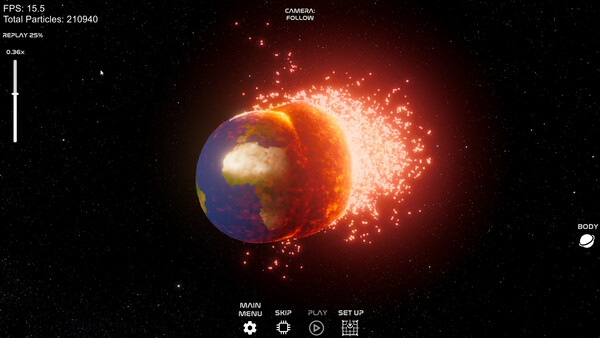
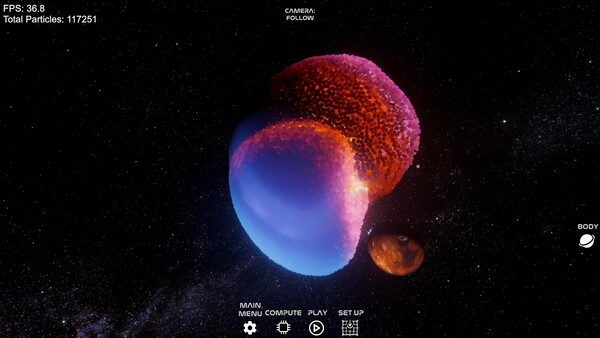
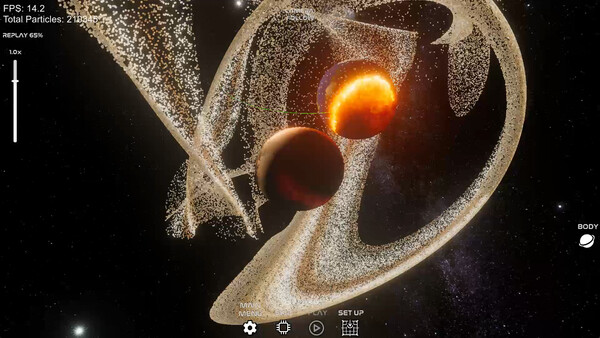
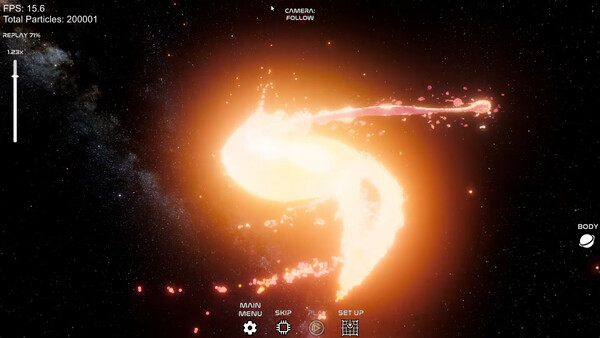
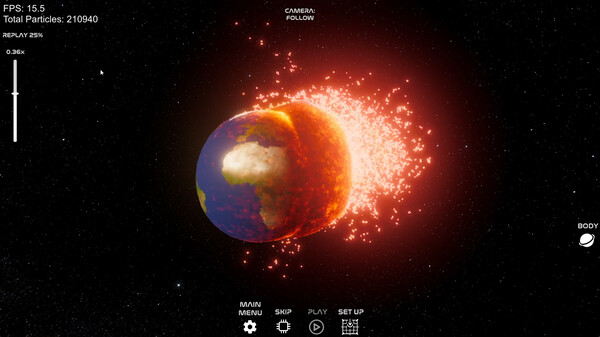
Space Crash Simulator is a real-time planetary collision sandbox built on GPU-accelerated Smoothed Particle Hydrodynamics — the same class of method used in scientific impact simulation. Every planet, star, and fragment is made of individual particles that attract, compress, melt, and break apart under the forces you set up. Nothing is scripted: fragmentation, shock fronts, tidal stretching, moon formation and accretion all emerge from the equations.
There are no missions and no objectives. You set the initial conditions, press play, and watch what physics does with them.
Scale
Real-time simulation of hundreds of thousands of particles
COMPUTE mode pre-calculates collisions of up to 1,000,000 particles per planet on a modern GPU, streaming to disk for long recordings
Replay with rewind, scrubbing, slow motion and reverse — watch the same impact from any angle, as many times as you want
Gravity solved with a Barnes-Hut octree: every particle pulls on every other one, at scales where summing the pairs directly would be a trillion interactions per step
Build the bodies
Draw your own shapes: sketch a silhouette and extrude or revolve it into a 3D body, with a live preview — then crush it under its own gravity
Spheres, hollow spheres, cubes, walls, discs, rings, sieves, and a lattice space-frame that buckles and shears instead of shattering
Make any body indestructible: unbreakable walls, unstoppable projectiles
Planet textures built in or imported from your own images; procedurally granulated star surfaces
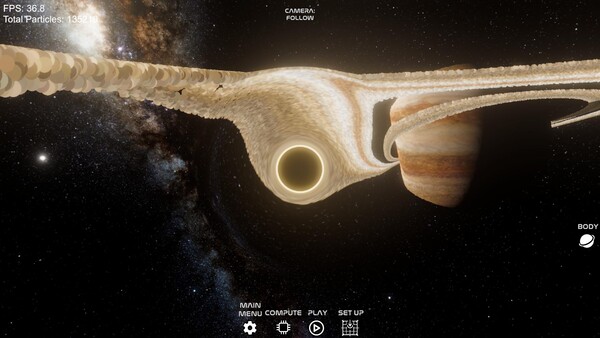
Black holes with accretion discs, gravitational lensing, and tidal disruption
Control the physics
Particle count, mass, viscosity, rest density
Impact velocity, spin, inclination
Impact heating, thermal conduction, radiative cooling
Orbit presets: circular, elliptical, and Roche-limit — one click puts a moon exactly where you want it
Simulation modes
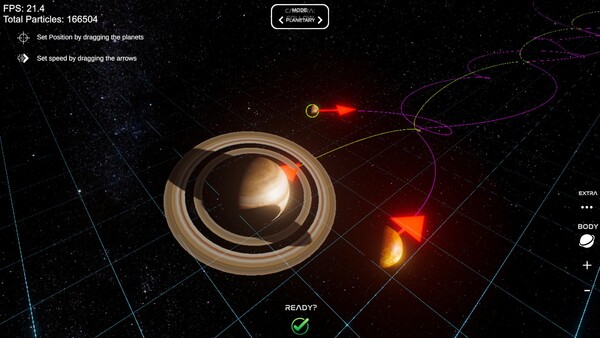
Planetary mode: build a system of planets, moons, walls, black holes and painted shapes, and collide them however you like: head-on impacts, glancing blows, or chaotic multi-body dynamics where tiny differences in setup produce wildly different outcomes
Protoplanetary disc + star: accretion and early system evolution
Galaxy mode: large-scale gravitational interactions between galactic cores (gravity only; SPH does not apply at that scale)
What this is, and isn't
Space Crash Simulator is an open-ended physics tool for people interested in astrophysics, orbital mechanics, impact dynamics, and scientific visualization, or anyone who wants to build a scenario and watch it play out. There is no storyline, no progression system, and no competitive mechanics. The focus is entirely on constructing situations, adjusting parameters, and observing the physical behaviour that follows.