
SpaceSim - Astrophysical Simulation Software
SpaceSim - Astrophysical Simulation Software - Steam Charts & Historical Stats
Simulation & rendering software that uses Smoothed Particle Hydrodynamics (SPH) to simulate collisions of celestial bodies, accretion disks around black holes, or formation of galaxies in the... Explore historical player activity and pricing for SpaceSim - Astrophysical Simulation Software. Player-count data was last observed Sep 28, 2026.
SpaceSim - Astrophysical Simulation Software player count and price summary
- Current players
- Unavailable
- All-time peak
- 46
- 24-hour player change
- Unavailable
- Current US price
- $14.99
Player count last observed . Values marked unavailable are not estimated.
Media gallery 6 screenshots · 1 videos
Screenshots
Videos
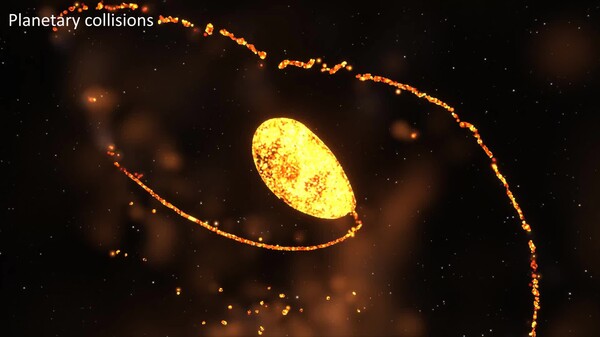
SpaceSim Trailer
Last Tracked Players
All-Time Peak
Estimated Owners
Game Insights
Buy Verdict
Wait for upcoming sale in ~2 days for potentially better pricing.
Value Score
Price-to-player ratio ranks in the 100th percentile.
Genre Benchmarks
Activity Heatmap
42 players · 1 samples
30 players · 1 samples
34 players · 1 samples
No samples
28 players · 1 samples
21 players · 1 samples
No samples
22 players · 2 samples
No samples
22 players · 1 samples
27 players · 1 samples
22 players · 1 samples
No samples
27 players · 1 samples
29 players · 1 samples
No samples
No samples
38 players · 2 samples
No samples
38 players · 1 samples
25 players · 1 samples
No samples
38 players · 1 samples
40 players · 1 samples
37 players · 1 samples
No samples
21 players · 1 samples
21 players · 1 samples
No samples
15 players · 2 samples
No samples
No samples
14 players · 2 samples
No samples
13 players · 1 samples
21 players · 1 samples
20 players · 1 samples
No samples
28 players · 1 samples
31 players · 1 samples
No samples
No samples
38 players · 2 samples
No samples
No samples
32 players · 2 samples
No samples
35 players · 1 samples
22 players · 1 samples
No samples
31 players · 1 samples
18 players · 1 samples
26 players · 1 samples
No samples
15 players · 2 samples
No samples
No samples
17 players · 2 samples
No samples
20 players · 1 samples
18 players · 1 samples
No samples
19 players · 1 samples
25 players · 1 samples
No samples
21 players · 1 samples
No samples
19 players · 1 samples
28 players · 1 samples
No samples
22 players · 1 samples
32 players · 1 samples
No samples
No samples
22 players · 2 samples
No samples
12 players · 1 samples
14 players · 1 samples
No samples
12 players · 1 samples
13 players · 1 samples
19 players · 1 samples
No samples
18 players · 1 samples
19 players · 1 samples
No samples
18 players · 1 samples
19 players · 1 samples
No samples
21 players · 1 samples
28 players · 1 samples
No samples
No samples
25 players · 1 samples
20 players · 1 samples
No samples
22 players · 1 samples
24 players · 1 samples
No samples
13 players · 1 samples
13 players · 1 samples
No samples
8 players · 1 samples
9 players · 1 samples
7 players · 1 samples
No samples
12 players · 1 samples
9 players · 1 samples
No samples
No samples
16 players · 1 samples
22 players · 1 samples
No samples
22 players · 1 samples
16 players · 1 samples
No samples
No samples
21 players · 2 samples
No samples
No samples
20 players · 1 samples
23 players · 1 samples
No samples
16 players · 1 samples
14 players · 1 samples
No samples
12 players · 1 samples
15 players · 1 samples
No samples
14 players · 1 samples
17 players · 1 samples
No samples
23 players · 1 samples
19 players · 1 samples
No samples
No samples
24 players · 2 samples
No samples
No samples
19 players · 1 samples
22 players · 1 samples
No samples
32 players · 1 samples
No samples
25 players · 1 samples
No samples
No samples
28 players · 1 samples
No samples
No samples
18 players · 1 samples
No samples
No samples
19 players · 1 samples
No samples
No samples
19 players · 1 samples
25 players · 1 samples
No samples
32 players · 2 samples
38 players · 4 samples
No samples
No samples
36 players · 2 samples
No samples
42 players · 1 samples
31 players · 1 samples
No samples
Price History
No Recent Price History
Price history data will appear here once more pricing information becomes available.
System Requirements
- Requires a 64-bit processor and operating system
- OS: Windows 10
- Processor: CPU supporting SSE 4.1
- Memory: 4 GB RAM
- Graphics: GPU supporting OpenGL 4.6
- Storage: 500 MB available space
- Requires a 64-bit processor and operating system
- OS: Windows 10 or 11
- Processor: CPU supporting SSE 4.1
- Memory: 16 GB RAM
- Graphics: GPU supporting OpenGL 4.6 with 4 GB VRAM
- Storage: 10 GB available space
- Additional Notes: CPU determines how fast the simulation can run. Generally, more cores = more speed.
- Processor: CPU supporting SSE 4.1
- Graphics: GPU supporting OpenGL 4.6
- Storage: 500 MB available space
- Processor: CPU supporting SSE 4.1
- Graphics: GPU supporting OpenGL 4.6 with 4 GB VRAM
- Storage: 10 GB available space
- Additional Notes: CPU determines how fast the simulation can run. Generally, more cores = more speed.
Additional Information
Player-to-Price Ratio
Current Pricing
Additional Information
Developer Analytics
Loading competitors...
About This Game
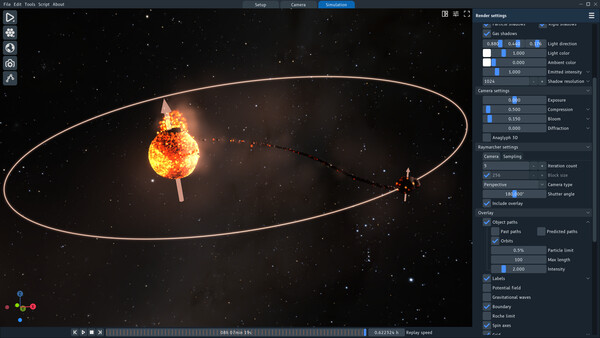
Simulation & rendering software that uses Smoothed Particle Hydrodynamics (SPH) to simulate collisions of celestial bodies, accretion disks around black holes, or formation of galaxies in the early universe.
Detailed Description
SpaceSim is a particle-based simulation and rendering software, primarily focused on astrophysical applications.
Important!
This is a non-realtime simulator. Although low-resolution simulations are fast enough to be real-time, simulations with millions of particles can take several hours to finish.
This is not a game. It does not contain any game mechanics, progression, sandbox elements, etc. Please do not expect any gaming experience.
The goal of the project is to "de-mystify" scientific simulations and make them accessible to the general public. SpaceSim uses the same approach (albeit simplified and at lower resolution) as the research simulations typically run on supercomputers, but it can run on your desktop PC or laptop, comes with an intuitive user interface, and requires no extensive knowledge of mathematics, physics, or programming.
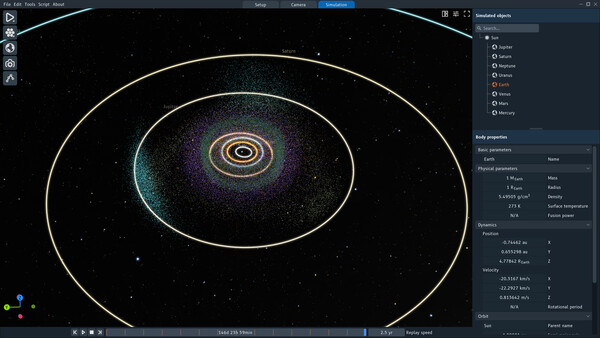
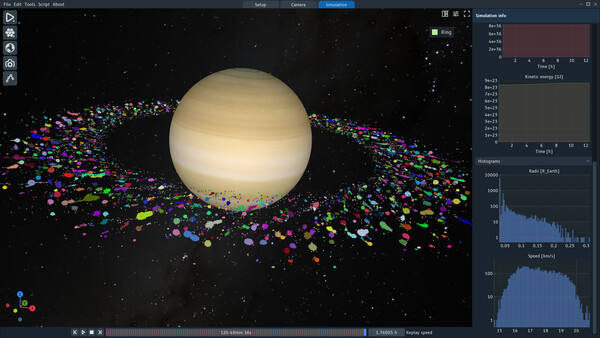
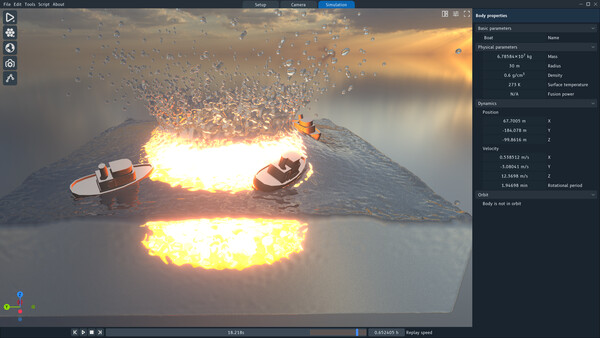
You can recreate some of the well-known simulations from the scientific literature, such as the Moon-forming impact, the formation of the ring system of Saturn, or the DART kinetic impactor. Or you can simply explore various initial conditions, both grounded and realistic, but also hypothetical "what-if" scenarios, such as the collision of two planets made of matter and anti-matter.
Fluid dynamics and gravitation
Each deformable object in the simulation is discretized into particles that interact with each other through collisions (by solving the Navier-Stokes equations) and gravitational attraction. Objects can also be rigid (non-deformable) - they retain their shape, which simplifies collisions between objects and optimizes simulation speed.
The particle-based solver is useful for simulating a number of astrophysical events, such as the formation of planets from protoplanetary disks or the mutual interaction of galaxies.
Object customization
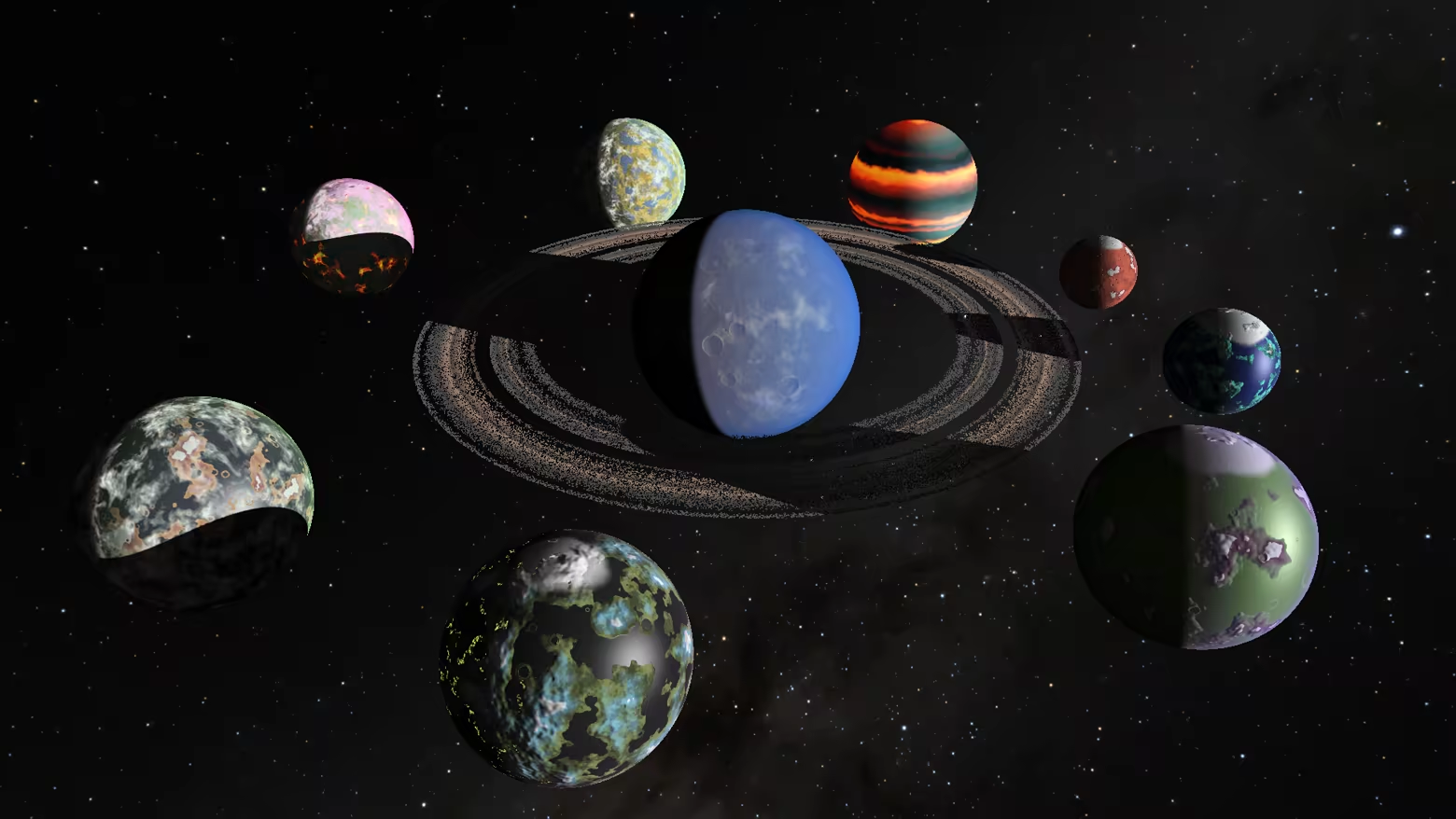
The application has a number of object types - planets, stars, asteroids, disks, clouds, galaxies, and more. Each object has adjustable parameters that allow you to change its geometry, materials, appearance, and simulation behavior. The surface textures of planets and asteroids can be further tailored using procedural generation or by uploading custom images.
Or, if you need even more control, create your own objects using the Lua scripting language.
Black holes (and white holes)
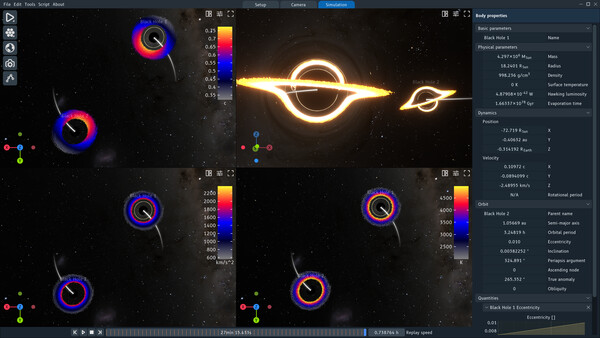
The renderer includes the effect of gravitational lensing, bending the light rays that pass close to a black hole and creating realistic renderings of warped accretion disks, duplicated images of objects behind black holes (including other black holes) or Einstein rings of galaxies.
Particle colors and gravity visualization
SpaceSim provides additional insights into the simulation in a number of ways. It can color particles based on values of a specific quantity (velocity, pressure, material, ...), show the Roche limit indicating where satellites can have stable orbits, or draw the potential field to see the gravity wells around celestial bodies.
Key features:
CPU and GPU simulation solver
Optimized gravity simulation using the Barnes-Hut algorithm
Simulation history - store the entire simulation and replay it later
Two render engines - Real-time or Raymarcher
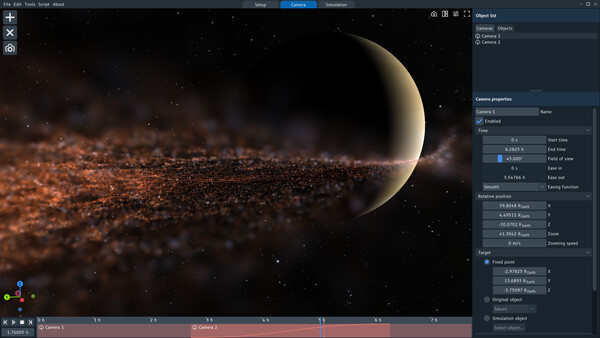
Customizable camera paths with object tracking
Lua scripting for custom objects and simulation systems
Built-in video recording (H.264 codec) and various export options (Alembic, OpenVDB)