
Kıvam
Kıvam - Steam Charts & Historical Stats
A calm marbling craft set in 18th-century Istanbul. Explore historical player activity and pricing for Kıvam. Player-count data was last observed Sep 29, 2026.
Kıvam player count and price summary
- Current players
- Unavailable
- All-time peak
- Unavailable
- 24-hour player change
- Unavailable
- Current US price
- Price unavailable
Player count last observed . Values marked unavailable are not estimated.
Media gallery 6 screenshots · 1 videos
Screenshots

Videos

KIVAM
System Requirements
- Requires a 64-bit processor and operating system
- OS: Windows 10 64-bit
- Processor: Intel Core i3-8100 / AMD Ryzen 3 1200
- Memory: 8 GB RAM
- Graphics: NVIDIA GeForce GTX 750 Ti / AMD Radeon R7 260X / Intel Iris Xe
- DirectX: Version 11
- Storage: 2 GB available space
- Requires a 64-bit processor and operating system
- OS: Windows 11 64-bit
- Processor: Intel Core i5-9400 / AMD Ryzen 5 2600
- Memory: 8 GB RAM
- Graphics: NVIDIA GeForce GTX 1060 / AMD Radeon RX 580
- DirectX: Version 12
- Storage: 2 GB available space
Additional Information
Current Pricing
Additional Information
Developer Analytics
Loading competitors...
About This Game
A calm marbling craft set in 18th-century Istanbul. Float pigment on water, comb it open, lift it onto paper — every pattern happens once and never returns. In the wake of master Hatip Mehmed Efendi.
Detailed Description
Marbling — ebru — is an art indebted to water. You float pigment on its surface, comb it open, and lift the pattern onto paper. In Kıvam you stand at the bench of an early-18th-century Istanbul master, where the word kıvam names the exact consistency paint must reach before it will float. Each tray is a decision; each lift, an act that cannot be undone.
This is the moment marbling turned from the abstract battal tradition toward a floral, figurative language — a turn that still carries its maker's name: hatip ebrusu, the preacher's marbling. You work in the wake of Hatip Mehmed Efendi, one quiet sheet at a time.
The Craft
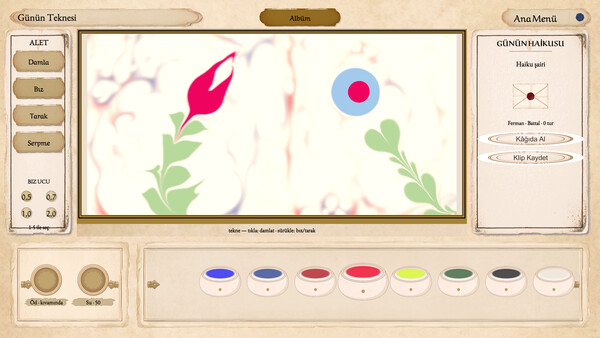
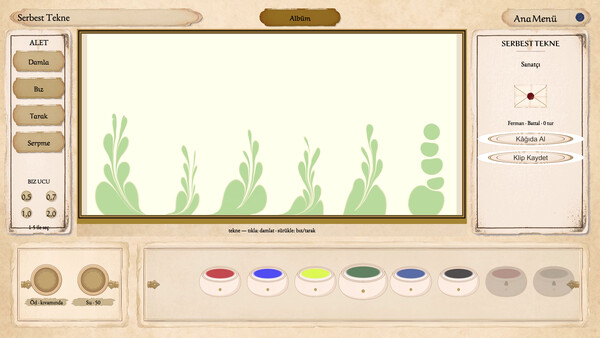
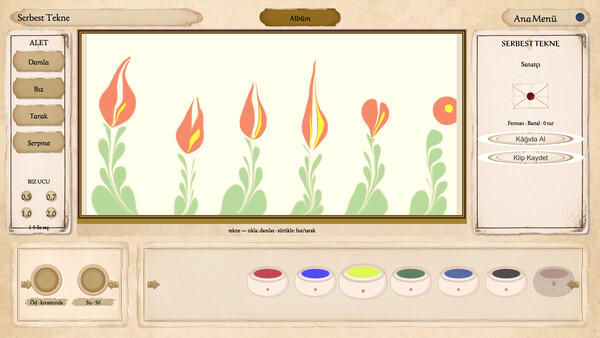
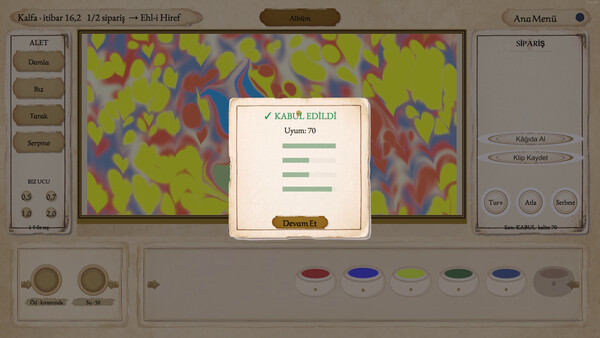
Four tools — drop, stylus, comb, and broadcast — and a rack of pigments you mix at your own rhythm. There is no undo and no single correct result; only the pattern that forms under your hands, this once.
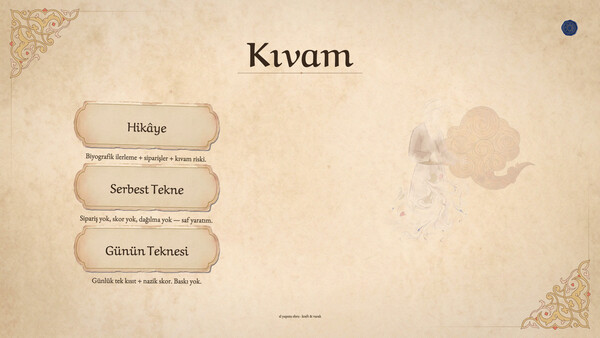
Three Ways to Work the Water
Story — Take commissions at the master's bench. Match each ferman, lift the sheet, and deliver it for a harmony score that carries your standing from apprentice toward master — with the ever-present risk that the paint loses its kıvam.
Free Tray — Every pigment open. No commission, no score, no failure. Pure making.
The Daily Tray — One shared tray each day, paired with the day's haiku. The same water sets the same terms for everyone; once that day's sheet is lifted, it will not open again. A gentle score, never pressure.
Every Pattern Is Yours
No two trays resolve the same way. Keep what you lift in your album and watch a quiet body of work gather — a record of mornings spent over the water.
Kıvam is not a production line but a workbench. It doesn't speed up and it won't hurry you. Whatever you lift from the water is yours — and it will never come again exactly the same.