
Powdertron
Powdertron - Steam Charts & Historical Stats
A physics sandbox built on real chemistry. Explore historical player activity and pricing for Powdertron. Player-count data was last observed Sep 28, 2026.
Powdertron player count and price summary
- Current players
- Unavailable
- All-time peak
- Unavailable
- 24-hour player change
- Unavailable
- Current US price
- Price unavailable
Player count last observed . Values marked unavailable are not estimated.
Media gallery 5 screenshots · 1 videos
Screenshots

Videos

Powdertron Trailer
System Requirements
- Requires a 64-bit processor and operating system
- OS: Windows 10 64-bit
- Processor: Dual-core 2.0 GHz with SSE2
- Memory: 4 GB RAM
- Graphics: OpenGL 3.3 compatible, 1 GB VRAM (Intel UHD 630 or better)
- Network: Broadband Internet connection
- Storage: 250 MB available space
- Sound Card: Any Windows-compatible device
- Requires a 64-bit processor and operating system
- OS: Windows 11 64-bit
- Processor: Quad-core 3.0 GHz or better
- Memory: 8 GB RAM
- Graphics: Dedicated GPU with Vulkan or OpenGL 4.5, 2 GB VRAM
- Network: Broadband Internet connection
- Storage: 500 MB available space
- Sound Card: Any Windows-compatible device
Additional Information
Current Pricing
Additional Information
Developer Analytics
Loading competitors...
About This Game
A physics sandbox built on real chemistry. Drop 674 materials into a falling-sand world and watch them react, burn, freeze and explode. Then wire circuits, test wings in a wind tunnel, or split light through lenses — alone or with friends online.
Detailed Description
Four simulators. One sandbox.
Powdertron is a physics playground where the chemistry is real. Its 674 materials — pure elements, compounds, alloys, minerals and industrial stock — each carry a genuine density, melting point, boiling point and formula, and 1,409 reaction rules decide what happens when they meet. Iron rusts. Sodium explodes in water. Limestone calcines. Nothing here is a lookup table of pretty colors.
Chemistry
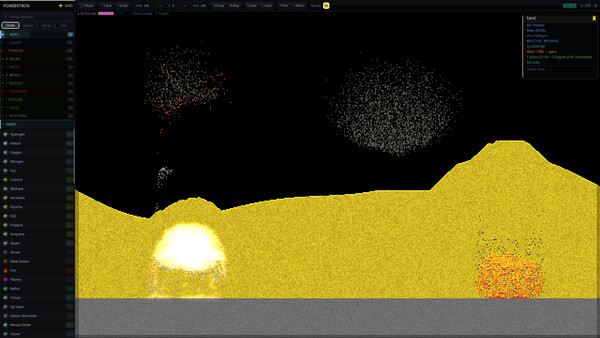
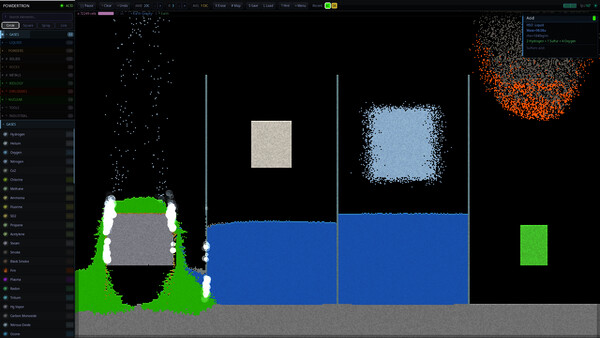
Paint sand, water, acid, thermite or plasma onto a canvas of up to 120,000 cells and let it run. Heat it, freeze it, set it alight, pull the air out to a vacuum or switch gravity off entirely. Phase changes, combustion, dissolution, radioactive decay, heat conduction and structural collapse all play out cell by cell in a multithreaded C++ engine — fast enough that a full canvas still runs smoothly.
Electronics
A real circuit simulator, not a wiring puzzle. Batteries, resistors, capacitors, inductors, logic gates, seven-segment displays and an oscilloscope, connected by actual nets rather than cell adjacency. Build something that works, package it into a named chip, and drop that chip into your next design.
Wind Tunnel
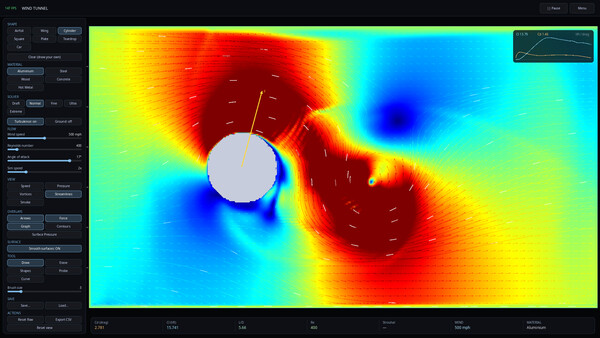
Draw a shape, put it in the airflow, and see what happens. A lattice-Boltzmann solver renders live streamlines, pressure across the surface of the body, and the point where the flow separates.
Optics Bench
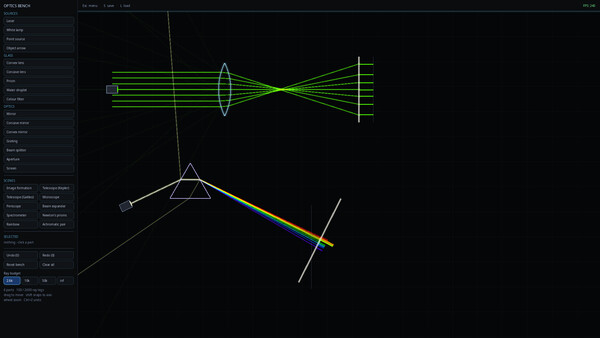
Lenses, mirrors and prisms with wavelength-accurate refraction. Split white light into its spectrum, chase a focal point, or build something that shouldn't work and find out why it doesn't.
Learn it by breaking it
Every material carries its real formula and properties, and reactions you trigger are logged as discoveries as you find them. A guided tutorial and a set of story challenges give you somewhere to start if a blank canvas is too much choice.
Build together
Host a session over Steam and share a canvas with friends. Everyone paints into the same world, sees each other's cursors, and watches the same simulation run. Name your worlds, give each its own physics settings, and lock the session with a password if you'd rather keep it private.
Make it yours
Add your own materials through the mods folder, save and load worlds, capture screenshots, and export measurement data straight to CSV for when the sandbox turns into an experiment.